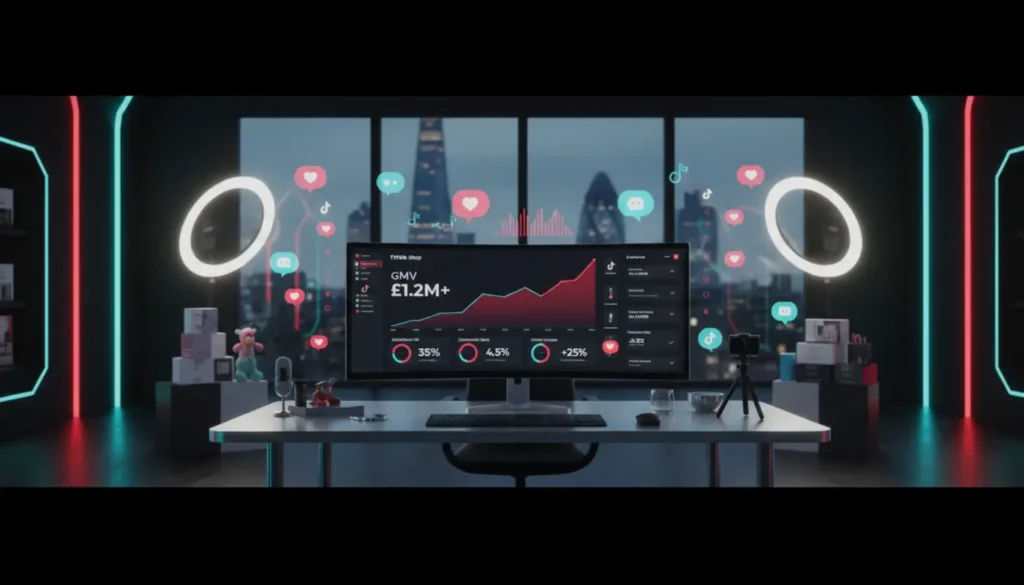
Are you running TikTok Shop ads but still unsure which numbers actually predict GMV growth?
Many brands and agencies struggle not because of poor creatives or small budgets, but because they focus on the wrong metrics inside TikTok Shop ad reporting. If you’re spending time looking at impressions, likes or basic CTR without tying them to revenue, you won’t understand what drives real results. Let me break this down in a simple and practical way.
At TSLA, we see this often. Brands spend every week but still cannot explain how their TikTok Shop campaign analytics relate to real Gross Merchandise Value growth. This guide will help you fix that.
TikTok Shop Ad Reporting And What Most People Miss
The real talk is this. TikTok is not Meta or Google. The usual performance marketing rules do not fully apply.
You may see:
- Strong video views
- High engagement
- Decent CTR
- Good traffic
- Low CPM
- Growing reach
- Plenty of add to carts
Yet your GMV barely grows.
What actually happens is TikTok Shop runs on content-driven buying behaviour. The algorithm cares more about watch time, intent and product interaction than likes or views. If your reporting is not tied to revenue signals, you’ll optimise for attention instead of profit.
TikTok Shop Ad Reporting Metrics That Predict GMV Growth
Let’s move forward on this properly. When we analyse TikTok Shop ads inside Ads Manager and Seller Centre, we look at three layers.
Layer 1 Revenue Metrics
The first layer is essential.
The core metrics you must focus on are:
Attributed GMV
Revenue linked to ad interactions within TikTok’s attribution window.
Cost Per Purchase
Ad spend divided by total attributed orders.
Return On Ad Spend
Revenue generated divided by ad spend.
For a deeper look at what good ROAS performance looks like, our TikTok Shop ROAS benchmarks and improvement guide explains this clearly.
It’s important to understand that GMV is not profit. As explained in TikTok Seller University, GMV is the total value of transactions before fees, returns and commissions. You can have strong GMV and still have weak margins.
Layer 2 Engagement Metrics That Show Buying Intent
This is where many advertisers go wrong.
CTR alone does not show buyer interest. One of the strongest predictors of GMV growth is video through rate.
Video through rate measures the percentage of people who watch past a certain point often 6 seconds or 75 percent of the video.
Why it matters:
Higher watch time often means stronger buying intent. A person who watches most of a demo or review is more likely to buy than someone who scrolls after two seconds.
When running ads inside our TikTok Shop Ads Management service, we look at:
- Video completion at 25, 50, 75 and 100 percent
- Click to order rate
- Paid conversion rate
- Product page view depth
If completion rates rise and cost per purchase drops, GMV growth usually follows.
Layer 3 Product Level Profitability
This is where serious scale comes from.
Do not only report overall ROAS. Break performance down by product.
- Cost per order per product
- GMV per product
- Conversion per product
- Repeat purchase behaviour
What often happens is one strong product drives most of the GMV while others waste spend. If your reporting does not separate product performance, you cannot scale properly.
Attributed GMV And Total GMV Explained
This area often causes confusion.
Attributed GMV includes sales linked to an ad click or view within TikTok’s attribution window.
Total GMV includes all Shop revenue paid, organic, affiliate, live and repeat purchases.
If someone asks why Ads Manager shows lower revenue than Seller Centre, the answer is simple.
Ads Manager shows attributed GMV.
Seller Centre shows total GMV.
A common mistake is adding both numbers together and reporting inflated results.
The correct way:
- Use attributed GMV for paid performance
- Use total GMV for overall growth
- Show percentage contribution from ads
How To Build A TikTok Shop Reporting Dashboard
Tier 1 Daily Monitoring
A quick five-minute check.
- Ad spend
- Attributed GMV
- Orders
- Cost per purchase
- Conversion rate
Look for unusual changes like sudden drops or creative fatigue.
Tier 2 Weekly Performance Review
A deeper thirty-minute check.
- Video through rate changes
- Cost per order by product
- Top performing creatives
- Audience performance
- Click to order rate
This is where real optimisation happens.
Tier 3 Monthly Strategy Review
A one-hour strategic session.
- Total GMV growth
- Blended ROAS
- Repeat purchase rate
- New vs returning customers
- Category performance
If you need help building your campaign structure before reporting matters, our TikTok Shop Ads guide for UK sellers covers the full setup.
How To Present Results To Stakeholders
Executives do not care about impressions. They care about:
- Cost per purchase
- Attributed GMV
- ROAS
- Week on week movement
- Contribution to total revenue
Here is a simple summary format:
- Headline revenue
- Cost efficiency
- Growth vs last period
- Key insight
- Next action
Example:
Attributed GMV grew 18 percent month on month.
Cost per purchase dropped from £21 to £17.
75 percent video completion improved 12 percent.
Next step is scaling winning UGC creative to wider audiences.
How Often To Review TikTok Shop Performance
Active scaling with high spend? Review daily.
Stable accounts under £10k per month? Weekly is enough.
Strategy and planning? Monthly.
Checking too often leads to emotional decisions. Checking too little leads to missed growth.
Linking Creative Performance To GMV Results
Not all content drives the same commercial outcome.
Across our accounts at TSLA Agency London, we usually see:
- UGC testimonials convert well
- Problem solution demos improve video through rate
- Live replay clips support retargeting
- Influencer videos support scale with cost control
Match video performance to revenue outcomes in your dashboard. If testimonial videos show high watch rates and low cost per purchase, they become the base for scaling.
Final Thoughts On TikTok Shop Ad Reporting
The real talk is this. Data is only useful if it guides action.
TikTok Shop reporting should not be about showing activity. It should show what drives growth.
Focus on cost per purchase, ROAS, attributed GMV and video through rate. Break performance down by product. Separate attributed GMV and total GMV. Build dashboards for daily, weekly and monthly decisions.
Do this well and you stop guessing. You start scaling.
Frequently Asked Questions
- What are the most important metrics to track in TikTok Shop ad reports?
Cost per purchase, ROAS, CTR, video through rate and GMV are the key metrics that influence profit and scale. - What is video through rate and why does it matter?
Video through rate shows how many viewers watched past 75 percent of a video. Higher watch time usually means stronger buying intent. - How should I present TikTok Shop ad performance?
Share cost per purchase, attributed GMV and ROAS with a simple week on week comparison. Keep the focus on revenue impact. - What is the difference between attributed GMV and total GMV?
Attributed GMV comes from ad interactions. Total GMV includes all Shop sales paid, organic and affiliate. - How often should I review TikTok ad performance?
Check daily for active campaigns and weekly for stable ones, with a monthly strategic review.
To take your reporting further, explore our full TikTok Shop Ads Management service for support and proven reporting tools.

Jessica is the calm in the chaos. When tech feels confusing or overwhelming, she’s the one who brings it back down to earth with clarity, reassurance, and a bit of humour. She has a talent for explaining things in a way that just makes sense, without the jargon or judgement. Around Cleartwo, she’s the friendly voice reminding everyone that no question is a bad one.